
Margot and Fine Considering: Local Shorts at the SJIWFF
St. John’s International Women’s Film Festival | Screening October 6:30pm at the Majestic
Maggie Burton
This year’s St. John’s International Women’s Film Festival (October 20th – 24th) brings five days of films to town, with virtual screenings available as well to folks across Newfoundland and Labrador. The programme for Friday Evening Shorts, subtitled “i can love you better” includes short films by Elizabeth Adams, Marthe Bernard, Schuchi Talati, Dana Puddicombe, Anushau Sheikh, Laurel Brady, and Ama Anane. Two of these women, Bernard and Puddicombe, are Newfoundland and Labrador directors, and their films, Margot and Fine, Considering, were a pleasure to watch for the purposes of this review.
Marthe Bernard’s Margot begins with the sound of a car approaching a pastoral bay landscape, and ends with the sound of approaching footsteps as the titular character sits by the ocean alone. In the opening scene, the car is transporting Margot (Allison Moira Kelly) and her lover of one year, a townie named Pete (Andrew James O’Brien) to Margot’s family’s bay home. By the ending scene at the beach, Margot smiles at someone offscreen who is walking towards her, but it’s not clear to the viewer who’s footsteps they are. Or whose footsteps Margot wants them to be.
Margot begins as a film about a typical night out the bay with your lover. Margot and Pete are not long settled in before Johnny (Stephen Oates) enters the house. He is introduced by Margot as a family friend. With Johnny, Margot reveals parts of herself that she can access due to being back in the bay. “You’re smoking babe,” says Pete to Margot. “Only when I’m out here.” It made me yearn to go home and reconnect with someone from my past around whom I feel most like myself.
Still from Margot by Marthe Bernard, playing Friday, Oct. 23 at the Majestic Theatre
The cinematography by Rodrigo Iñiguez is gorgeous. Candles and fire light the faces of Margot and her lovers; the climactic moment ends with the candles blown out. Kelly’s expressive silence when Margot isn’t talking builds in intensity throughout the film, giving the viewer the opportunity to really see Margot’s emotional landscape. When I read or write short fiction, I think a lot about how a character can become fully developed in a limited narrative space. Margot feels remarkably realized in the film’s fifteen minutes, and I appreciate how her often silent development offers a visual counterpart to the kind of character work I value in literature. The score, composed by Noah Gorelick, features plucked instruments, piano, and pedal steel. It provides a comforting but stimulating backdrop to the warmth and tension of the script, especially during periods with no dialogue.
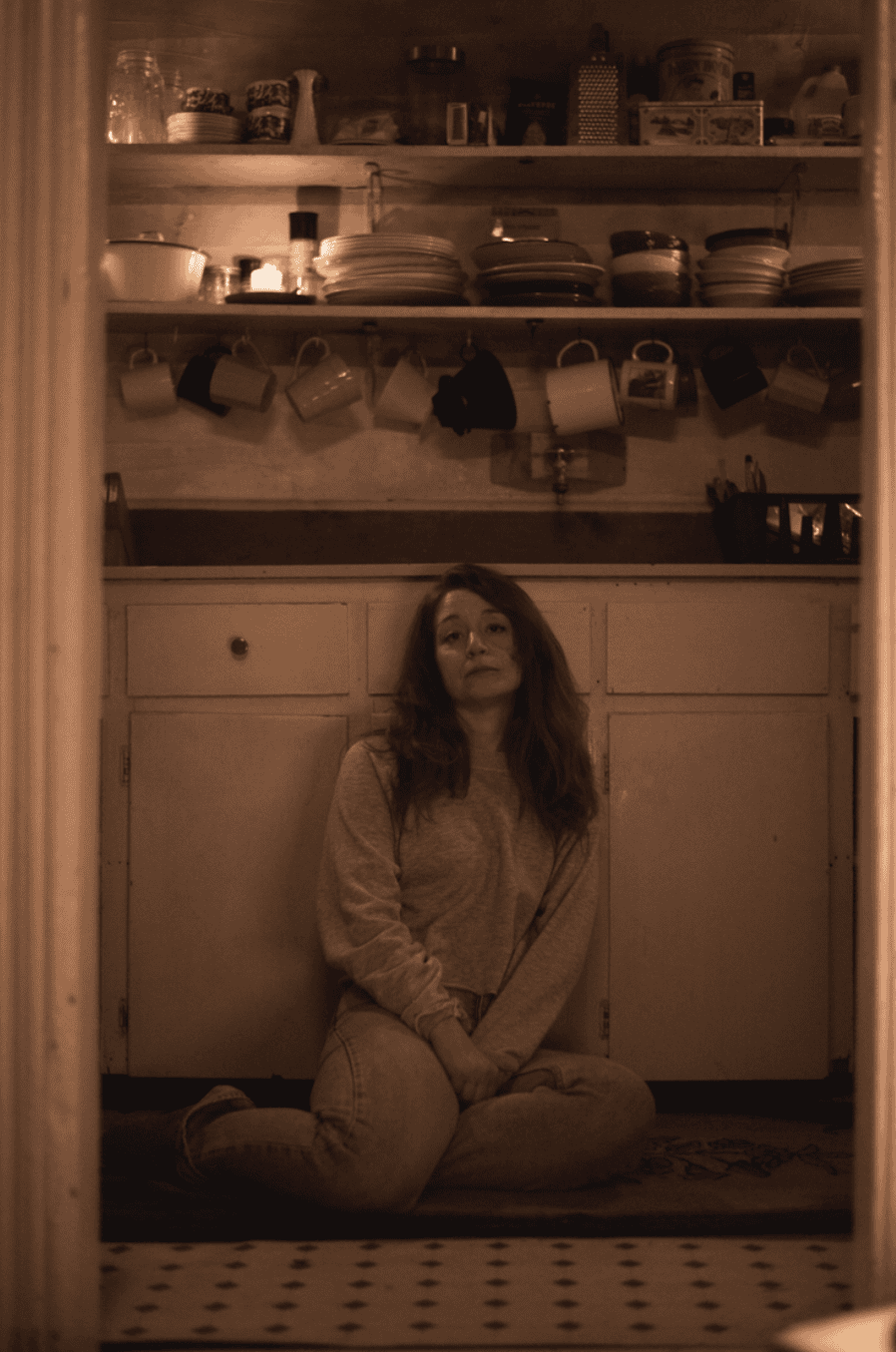
Fine, Considering by Dana Puddicombe follows a woman through quarantine during the Covid-19 pandemic after she flies back to St. John’s to see her mother, who has cancer. Unfortunately, her mother passes and Elizabeth (Rhiannon Morgan) struggles to process her feelings about the loss, and tells others on the phone that she feels guilty for being okay. “I’m starting to worry about myself because, well, I’m okay, and I feel bad about that. There’s a part of me that’s just turned off.” She can’t seem to get the obituary written, even though she promised her sister she would get it done.

Still from Fine, Considering, by Dana Puddicombe, screening Friday Oct. 23 at the Majestic Theatre.
As many of us do when we are threatened by experiencing the emotional weight of grief, Elizabeth becomes obsessed with something unrelated to the loss, in this case, the mouse in her rental. Only when the mouse is dead can Elizabeth feel anything but “fine” about the loss of her mother. The score was composed by Mara Pellerin, with wordless voices over spacey instrumental melodies in the first half of the film, switching to more rhythmic beats as Elizabeth plots to capture the mouse, and back to the original vibe again as more time passes in quarantine. The score enhances the mood of the film the whole way through, abruptly ending as Elizabeth finds the ability to feel the grief of her mother’s passing.
Puddicombe takes viewers back to spring 2020 with precision, capturing the experience of coming home and being in quarantine, not allowed to see our loved ones, to be comforted, loved, held. The pain that accompanies being alone during a difficult time. Many of us know it well. But there’s a hopeful message central to the film. If you’re in lockdown mode within your own emotional world, give it time, keep trying to feel things again. “What else to do but wait?” Elizabeth asks. Indeed.
Maggie Burton is a writer and musician from Brigus, Newfoundland and Labrador. She is the author of one book of poetry, Chores (Breakwater Books, 2023), and one book of short fiction, A Temporary Grace (Breakwater Books, 2026). In 2024, the Griffin Poetry Prize awarded Chores the Canadian First Book Prize.